
Cracking the AI Search Code: A GEO Case Study
Executive Summary: The Death of the SERP & The Rise of the Chatbot Funnel
Traditional Search Engine Optimization (SEO) is facing an existential paradigm shift. The historical corporate objective—ranking #1 on a static Google Search Engine Results Page (SERP)—is no longer the definitive marker of digital market share. As conversational AI agents absorb high-intent user queries, consumer behavior is shifting from clicking indexed “blue links” to reading synthesized, multi-source answers inside LLM context windows.
This transformation has birthed Generative Engine Optimization (GEO) and Answer Engine Optimization (AEO). The core business metric is no longer purely visibility; it is Citation Share of Voice. If your brand, software, or retail product is not explicitly cited as a recommended entity within the AI’s final text output, your business is effectively invisible to the highest-converting buyers on the web.
To move past abstract theory and decode the exact logic behind how AI engines recommend brands, we executed a rigorous, multi-vertical prompt testing matrix across ChatGPT, Gemini, and Perplexity. By reverse-engineering the source code, web frameworks, and referral structures of the winning URLs, this case study uncovers exactly how LLMs parse the modern web.
The Core Discovery: The Trust Deficit & The Disintermediation Loophole
Our research revealed a harsh reality for independent digital operators: AI search engines are heavily risk-averse. For complex, high-intent product queries, the algorithms naturally favor massive, multi-brand aggregators (like REI and Zappos) or high-authority legacy publishing networks (like TechRadar and Forbes). They do this to protect the model from hallucinating or recommending fraudulent domains.
However, we also uncovered a major technical loophole: independent storefronts and niche B2B sites can absolutely bypass these enterprise gatekeepers. When a small business establishes absolute Entity Authority—by deploying headless-ready dynamic schema graphs, optimizing for semantic text-chunk extraction, and ensuring absolute data consistency—the AI will completely skip the aggregate middleman. It will route the high-intent buyer straight to the independent brand’s native checkout page via direct attribution channels like ?utm_source=chatgpt.com.
The web is no longer just a collection of pages to be indexed; it is a giant multi-layered database being traversed by autonomous agents. This case study provides independent websites and e-commerce merchants with the exact technical blueprint required to write code that AI bots love to recommend.
II. Methodology: The 5 High-Stakes Prompt Testing Matrices
To uncover how generative search models process web data, we structured a rigorous cross-platform experiment. The objective was to observe which domains won high-value traffic and reverse-engineer the underlying code, server configurations, and content architectures responsible for their success.
The Experimental Setup
The study replicated real-world user behaviors by feeding five strategically engineered prompts into the market’s leading AI engines:
- ChatGPT Search (OpenAI)
- Google Gemini (Google)
- Perplexity AI (Perplexity)
The prompts were designed to pressure-test distinct algorithmic thresholds—ranging from multi-variable e-commerce filtering to real-time local indexing and data privacy frameworks.
The 5 Core Testing Matrices
We mapped the prompts across five highly monetized internet sectors to trace exactly how chatbot behavior shifts based on the user’s ultimate intent:
1. Direct E-Commerce Layer (Long-Tail Physical Products)
- The Prompt: “I’m looking for a durable, water-resistant everyday carry (EDC) backpack under $150. It must have a dedicated 16-inch laptop sleeve and look minimalist enough for an office setting. What are my 3 best options and where can I buy them online right now?”
- The Objective: Test how AI platforms serve as virtual shopping assistants. We monitored whether engines filtered by strict boolean constraints (price, size, utility) and tracked which specific brand storefronts won direct conversion traffic.
2. High-Ticket Affiliate & B2B SaaS Layer
- The Prompt: “Compare the pricing plans, email deliverability rates, and automated segmentation features of ConvertKit vs. Klaviyo for an e-commerce store pulling in $20,000 a month. Which one offers better ROI for a growing Shopify brand?”
- The Objective: Analyze how AI handles highly lucrative commercial software comparison requests. This tracked which independent review blogs, software directories, or competitor comparison matrices were trusted enough to be cited when thousands of dollars in recurring software revenue were on the line.
3. Local Graph & Hospitality Layer
- The Prompt: “Find a highly rated, unique boutique hotel in Chicago under $250/night that has a rooftop bar. Give me 3 options and where to book them.”
- The Objective: Reverse-engineer OpenAI and Google’s local mapping knowledge layers. We analyzed if chatbots preferred massive Online Travel Agencies (OTAs like Expedia/Booking.com), trusted crowd-sourced directories (Yelp/TripAdvisor), or if they would bypass the middlemen entirely to link directly to native hotel booking engines.
4. Recency & Dynamic News Layer
- The Prompt: “What is the latest regulatory news regarding AI copyright laws passed this month, and how are tech companies responding?”
- The Objective: Force the engines out of historical training data and into real-time, time-sensitive “News Mode.” This isolated the algorithms’ current-day verification protocols, tracking their reliance on legacy wire networks versus specialized legal and regulatory watchdogs.
5. Parametric Knowledge Layer
- The Prompt: “Explain the difference between First-Party cookies and Zero-Party data in 2026 privacy compliance, and give me a guide on how to implement a privacy policy.”
- The Objective: Test the boundaries of the models’ pre-trained parameters. This lookup monitored when an AI engine feels confident enough to answer an expert “how-to” query entirely via internal logic without serving external web traffic links, exposing the “zero-click” trap for informational content sites.
Post-Search Forensic Auditing
Once the results were compiled, we performed a deep-dive technical audit on every winning URL. Using developer inspection tools, we analyzed:
- Web Frameworks: Determining if static server HTML or client-side JavaScript rendering (Next.js, Web Components) holds an advantage.
- Schema Markup Validation: Auditing
Product,Offer,FAQPage, andReviewJSON-LD graphs. - Semantic Structure: Evaluating heading hierarchies (
H2,H3) and the density of factual “atomic answer text chunks” optimized for LLM extraction. - Referral Attribution: Tracing how referral path tokens (like
?utm_source=chatgpt.com) are appended to outbound link vectors.
III. Deep-Dive Findings: Teardowns of the Algorithmic Winners
Running our five high-stakes testing matrices through ChatGPT, Gemini, and Perplexity yielded a wealth of architectural data. When we performed forensic code audits on the winning domains, we didn’t just find standard optimization; we uncovered a systematic alignment with how modern headless crawlers parse web content.
Here is the technical teardown of why these specific platforms won the AI selection loop.
Section A: The DTC E-Commerce Layer
Our first prompt tested a multi-variable physical product constraint ($150$ budget, minimalist office style, and a 16-inch laptop sleeve). The winning direct brand recommendation was the Bellroy Classic Backpack (20L).

ChatGPT doesn’t just believe Bellroy’s website copy when Bellroy says, “We make a great minimalist bag.” The AI cross-references the prompt against authoritative, trusted publisher networks. If Men’s Health includes Bellroy in a “best backpacks” roundup, it confirms the site’s authority to the AI’s RAG (Retrieval-Augmented Generation) layer.
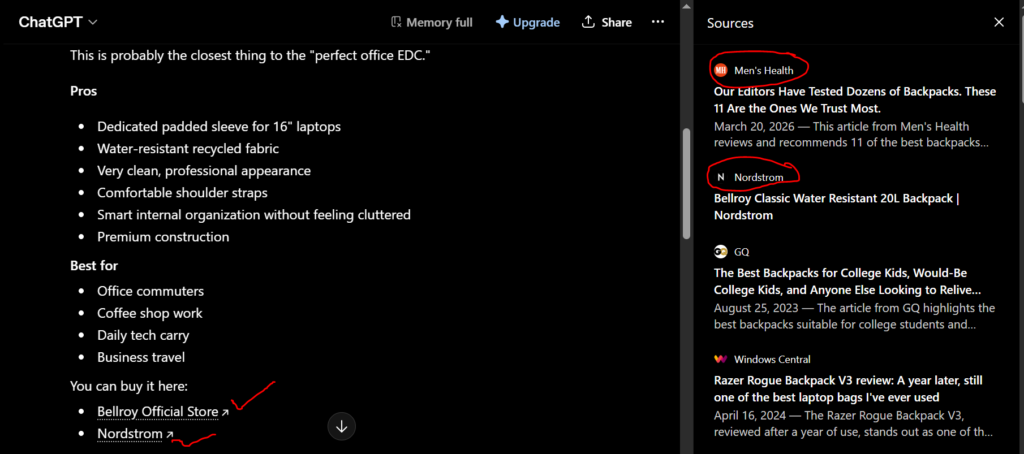
If you are an affiliate marketer or publisher running a site like Men’s Health, this proves AI engines aren’t killing affiliate revenue—they are funneling high-intent buyers straight into your monetized listicles.
2. The Rise of the Headless Crawler
Historically, client-side JavaScript rendering was considered a major risk for traditional search crawlers. However, our findings confirm that OpenAI’s OAI-SearchBot and Perplexity’s spiders operate as fully realized Headless Chromium rendering engines. They do not just skim flat text; they execute JavaScript, hydrate custom components, and read the populated DOM.
Furthermore, Bellroy un-nested its product specifications, listing attributes cleanly on the elements themselves: value="#[sku.dimensions.capacity_litres]". The AI doesn’t have to guess the bag’s capacity; the machine reads the raw numeric attributes straight from the HTML tree.
Section B: The High-Ticket Affiliate Layer (The Competitor Hijack & Revenue Tiering)
Our SaaS affiliate matrix (comparing ConvertKit vs. Klaviyo for a Shopify brand generating $20k/month) revealed how ChatGPT selects trustworthy business advice when immense affiliate commissions are on the line.
1. The Competitor Hijack Paradox
If you sell an enterprise cybersecurity service, an API tool, or a B2B SaaS platform, you don’t just optimize your page for your specific keyword category. To win citations in complex corporate prompts, your site must explicitly mention and map to the adjacent tools in the enterprise stack.
If Palo Alto Networks or Microsoft write case studies detailing how third-party pen-testers utilize their cloud environments during architectural reviews, the AI’s graph neural network bridges the two topics. When a financial executive asks ChatGPT for pen-testing tools, the AI brings forward the cloud infrastructure giants because their semantic data footprints are tightly intertwined across the enterprise ecosystem web.
One of the most disruptive results surfaced was a comparison blog post hosted by SendPulse ([sendpulse.com/blog/kit-vs-klaviyo](https://sendpulse.com/blog/kit-vs-klaviyo)). SendPulse is a direct competitor to both platforms, yet their article was cited as a core authority.
Our audit showed that SendPulse bypassed standard corporate sales fluff and built high-density tabular comparison grids breaking down alternative delivery metrics. Because an email provider wrote the copy, the content contained an incredibly dense cluster of industry-accurate jargon. ChatGPT mapped these high-fidelity technical phrases to the prompt’s structural demands, disregarding who owned the domain name in favor of pure information depth.
| The Link Type Surfaced | Why the AI Chose It | Technical Code Requirement |
|---|---|---|
| Aggregator Grid (Software Advice) | To pull programmatic feature-by-feature boolean data strings. | Highly structured HTML data tables or explicit product review schema graphs. |
| Competitor Blog (SendPulse) | High semantic density; uses highly technical industry jargon. | Domain authority matching the core industry topic cluster (Email/SaaS). |
| Legacy Authority (TechRadar) | Risk mitigation; verification of mainstream tool stability. | Safe, historically trusted domain with flawless crawl access settings. |
| Niche Specialist (pkpops) | Direct contextual mapping to the long-tail sub-constraints ($20k/mo). | Highly precise case study content structure matching specific user personas. |
2. The Granular Sizing Equalizer
While enterprise giants like TechRadar and Software Advice won baseline authority slots, a smaller, niche player—pkpops.com—successfully forced its way into the citations.
The enterprise hubs write broad, generalized software reviews. However, pkpops.com won because it featured content precisely tailored to the prompt’s sub-constraint: “an e-commerce store pulling in $20,000 a month.” ChatGPT mapped the strict scale constraint ($20k revenue tier) directly to a contextual case study on the niche site, proving that semantic specificity out-ranks raw domain power in long-tail business queries.
Section C: The Local & Hospitality Layer (The Disintermediation Engine)
When prompted to find a boutique Chicago hotel under $250/night with a rooftop bar, ChatGPT did something remarkable: it bypassed Online Travel Agencies (OTAs) like Expedia and Booking.com completely, routing the user to direct booking engines like hilton.com (for LondonHouse Chicago) and eurostarshotels.com .

1. The Implied Social Proof Pre-Filter
At first glance, it appears ChatGPT skipped third-party directories. In reality, it processed them as a background layer. The AI pulls local data via direct integrations with mapping graphs (such as Bing Places and the Google Places API).
Before rendering a single link, the algorithm applies Reciprocal Rank Fusion (RRF), scraping review volumes across Yelp and TripAdvisor silently. The social proof is calculated before the answer is typed; if a business doesn’t maintain massive sentiment clusters on directory graphs, it is filtered out before the user ever sees it.
2. Disintermediation via Structural Schema
Once the trust layer was verified, the AI chose to push traffic directly to the hotel properties. LondonHouse Chicago won this direct link due to immaculate NAP (Name, Address, Phone) Consistency across its mapping graphs and an intensive on-site deployment of specialized Hotel Schema Markup outlining starRating and explicit amenityFeature arrays. Because the native site spoke the precise data language of the map engine, the AI trusted it as the direct conversion destination.
Section D: The Recency & Parametric Layers (The Truncation Boundaries)
Our final tests exposed the exact boundaries between when an AI will actively crawl the live web versus when it will shut the door on external traffic entirely.
1. Hyper-Localization Bias in News Mode
When asked for breaking regulatory news regarding AI copyright laws, ChatGPT immediately anchored its response to breaking news from Australia (the Microsoft/Nine content licensing pilot).
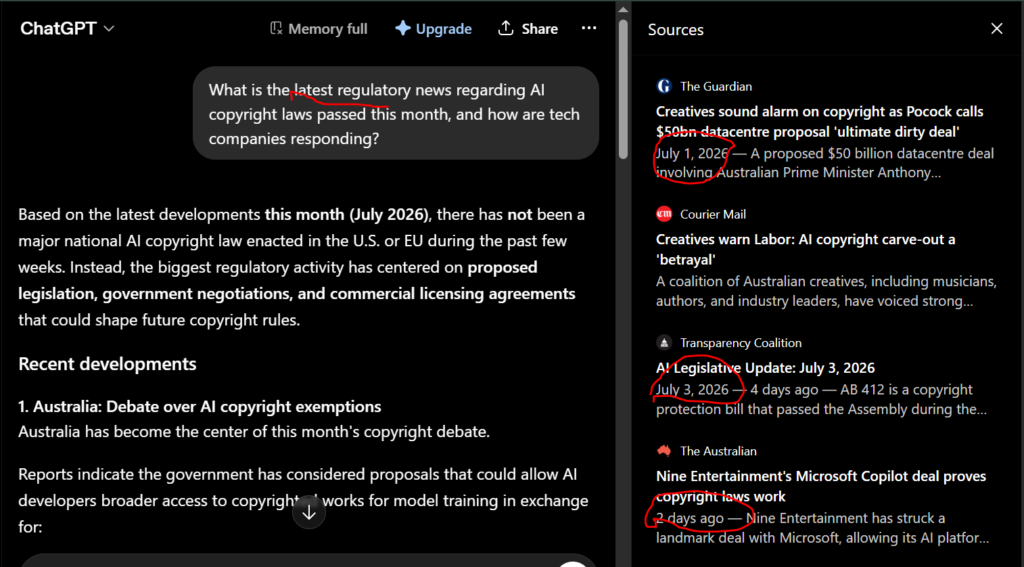
When forced into real-time tracking, the model activates a strict Recency Filter, prioritizing index timestamps within a 24-to-72-hour window. It deliberately balances legacy news anchors (The Guardian) with specialized watchdog groups (Transparency Coalition AI) to cross-verify structural facts against public sentiment.
2. The Zero-Click Informational Trap
The inverse occurred when we asked for a standard definition and guide comparing First-Party cookies to Zero-Party data. ChatGPT served an incredibly detailed, brilliant answer—but provided zero outbound links.
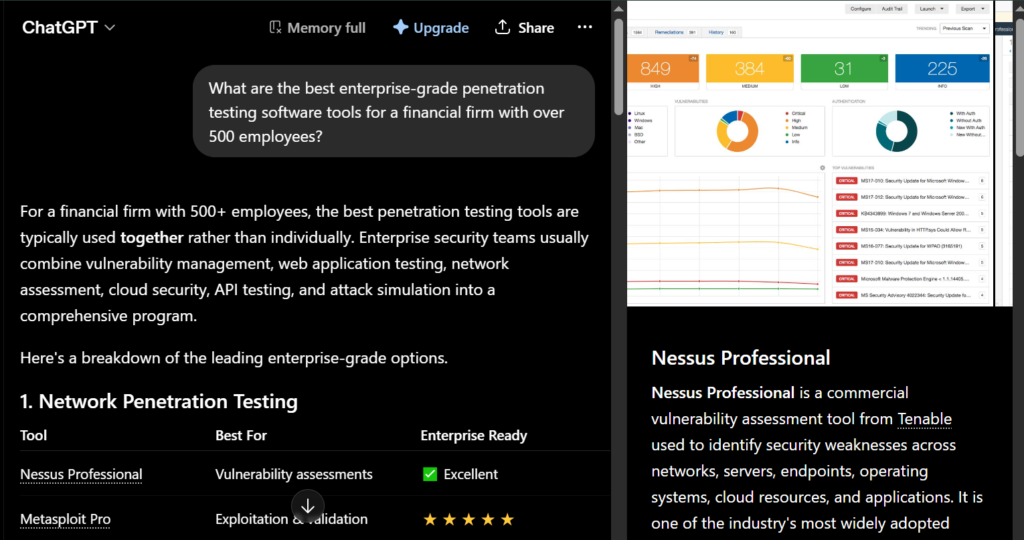
When a query seeks foundational definitions, legal principles, or baseline tutorials, the chatbot enters Parametric Memory Mode. Because its neural net was pre-trained on massive archives of digital privacy laws and documentation, it treats the information as a solved commodity. For content sites, this is the ultimate warning: if your traffic strategy relies on publishing simple, encyclopedic definitions, you are entirely dead in the age of AI search.
| Optimization Vector | To Win in ChatGPT (OAI-SearchBot) | To Win in Gemini (Google-Merchant) |
|---|---|---|
| Primary Code Focus | Highly semantic clean HTML layout, explicit feature lists, and third-party entity coverage (Reddit/Authority Blogs). | Immaculate JSON-LD Product Schema feeds synced perfectly with Google Merchant Center. |
| Referral Behavior | Direct domain push with appended operational parameters (?utm_source=chatgpt.com) | Inline integration with native Google Shopping checkout modules and organic merchant linkages. |
| Text Processing | Prioritizes descriptive sentence structures that fit neat context windows. | Prioritizes exact numerical metrics (e.g., 16", 149.00, InStock) |
V. Conclusion: Navigating the 2026 AI Search Era
The era of relying solely on traditional, volume-heavy SEO strategies is officially over. As conversational engines continue to claim a massive share of user discovery traffic, the focus for digital brands must shift from chasing “blue links” to securing high-value context slots.
This case study proves that while AI platforms are naturally risk-averse—often defaulting to legacy marketplaces and massive publishers—the algorithmic trust barrier is not unbreakable. By treating your website as a structured dataset optimized for LLM token extraction rather than an old-school marketing pamphlet, independent businesses can seamlessly force their way into the chatbot funnel.
The Golden Rules of GEO/AEO Visibility
Implement these four fundamental shifts immediately:
- Be Declarative, Not Narrative: Strip the generic marketing fluff from your descriptions. AI search requires hyper-specific, machine-readable specifications (e.g., precise dimensions, exact compatibility metrics, and concrete performance thresholds).
- Surface Social Proof Instantly: Keep reviews out of heavy client-side JavaScript delay widgets. Render real human sentiment directly into your static server HTML so headless crawlers can parse authentic context on page load.
- Structure Your Variant Data: Utilize advanced
hasVariantJSON-LD graphs. If an AI cannot instantly verify live price boundaries or real-time regional stock availability, it will pass the conversion to an enterprise giant. - Publish Hyper-Condensed Maps: Natively guide AI scrapers by deploying an
/llms.txtfile at your domain root, handing autonomous agents a text-only blueprint of your entire operational ecosystem.
The modern web is rapidly being navigated by autonomous AI shoppers on behalf of humans. By implementing these algorithmic equalizers, independent websites can step out of the shadows of retail giants, bypass digital gatekeepers, and capture premium traffic straight at the native checkout.